Two days after the ceasefire, regional air corridors are still disrupted rather than fully restored. Some countries have announced the reopening of their airspace, but the actual picture in the sky remains uneven. Based on open-source flight tracking, Emirates appears close to restoring much of its network, although the UAE had already tried throughout the war to keep as many flights operating as possible. Qatar, Jordan, and Israel are still operating only a limited number of flights, while Bahrain and Syria have also started to resume some services. [1][2]
At the same time, there is still very little visible non-military air traffic over Iraq and Kuwait, despite some formal reopening announcements. That suggests that airlines are still treating these corridors with caution, even where restrictions are being eased. Iran remains the clearest exception, with civilian flight activity still heavily disrupted. [1][3]
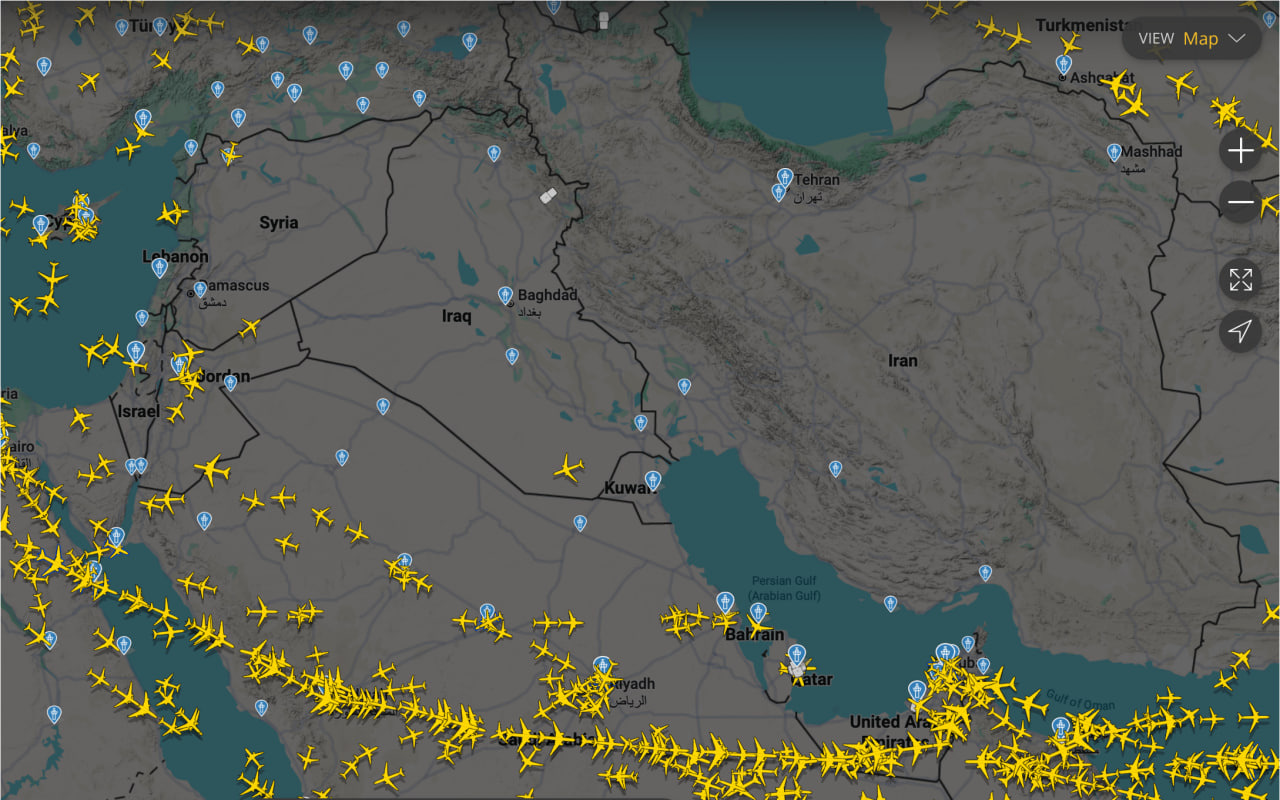
Status of the region’s airspace, 9th April, 19:30 UTC
So the clearest conclusion today is this: airspace reopening does not yet mean aviation normalization. Some routes are returning, and a few states are restarting operations, but the broader regional air network remains fragile, selective, and far from normal. On paper, more airspace is reopening; in practice, much of the region is still operating under a partial and highly cautious recovery. [1][2][3]
References:
[1] Wall Street Journal
[2] Anadolu Agency
[3] Reuters