Day 2 of the ceasefire is exposing one of its biggest ambiguities: does it include Lebanon or not? Washington and Israel say no, while Iran insists that Lebanon must be part of it. France and the UK have also argued that Lebanon should be covered, and Pakistan’s earlier mediation signals pointed in the same direction. That matters because continued Israeli strikes in Lebanon are now directly shaping Iran’s position on the Strait of Hormuz. [1]
On the maritime side, Iran’s position remains contradictory. Even as Iranian messaging suggested that the Strait of Hormuz was effectively closed again after the strikes on Lebanon, the IRGC issued new transit guidance for shipping: inbound traffic is to pass north of Larak Island, and outbound traffic south of it, with vessels coordinating with the IRGC Navy. Reuters reports that vessels are now being routed through waters around Larak Island, away from the deeper-water corridor closer to Oman that had normally been used before the war. In practice, this shifts transit into Iranian-controlled waters and into a shallower route than the main channel previously used. [2]
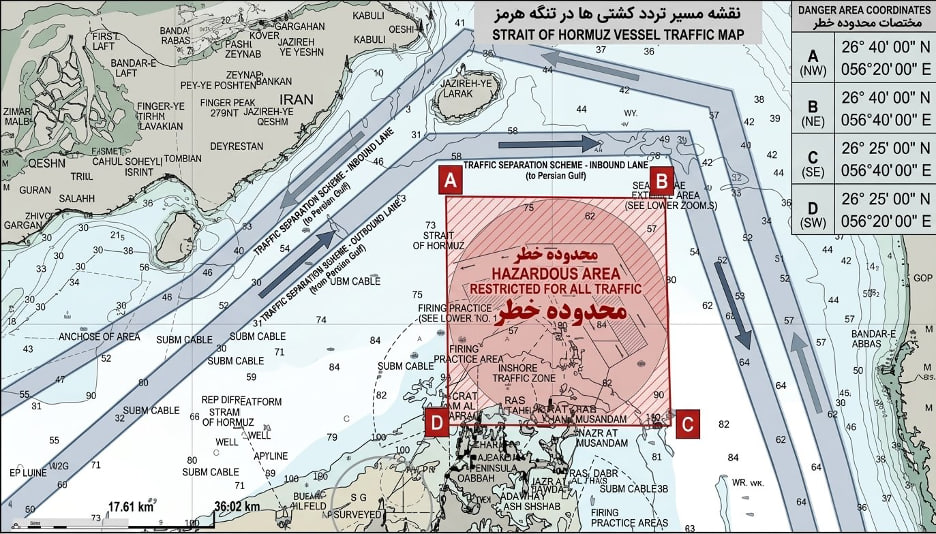
That matters because it shows that Hormuz is no longer functioning as a normal commercial transit lane. It is now operating as a restricted corridor under Iranian operational control, with passage dependent on Iranian instructions rather than standard navigation patterns. Reuters also reports that Iran may allow no more than 15 vessels per day, which would still leave traffic far below normal levels even if passage continues. [2][3]
Based on open-source vessel tracking, a limited number of non-Iranian ships still moved through the strait after the ceasefire. These include Dina Ocean, Marivex, MSG, Sara, Ocean Sky, and Lucky Gate. Dina Ocean and Marivex appear to have departed from Bandar Abbas, which may suggest Iranian-linked cargo. MSG, Sara, and Ocean Sky moved from the Gulf toward the Gulf of Oman, while Lucky Gate entered the Gulf through Hormuz. MSG also appears to be the first oil tanker to transit after the ceasefire, reportedly heading toward India. MAB 5, an LNG tanker, approached the passage and then turned back, so its transit remains unclear. Arhimeda is also already moving toward the strait.
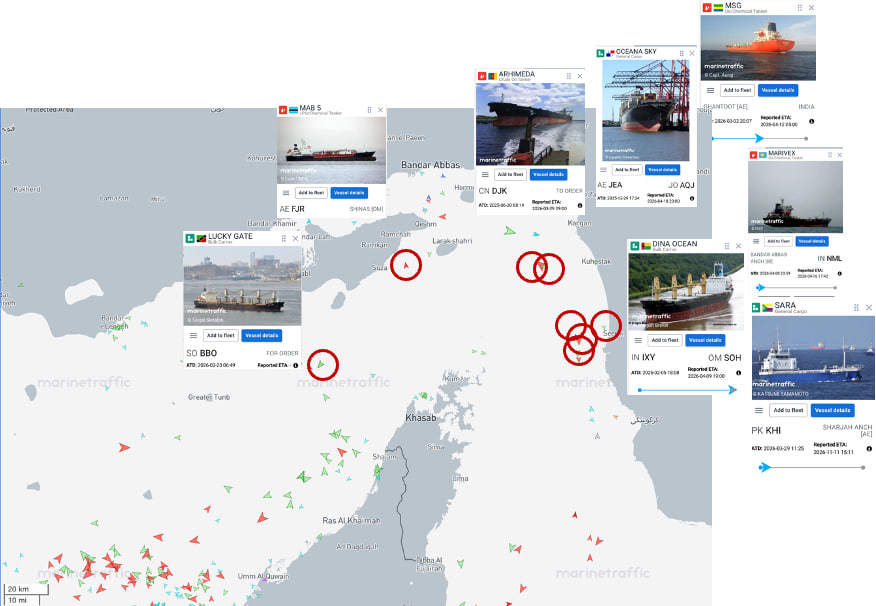
There is still uncertainty over how the new routing is actually being enforced. Based on my tracking, Ocean Sky and MSG appear to have exited using the line designated for inbound traffic, which suggests that enforcement may still be inconsistent or that some ships are being handled on a case-by-case basis. That ambiguity is itself part of the story.
So the clearest conclusion today is this: Hormuz is neither fully closed nor genuinely open. A small number of ships are moving, including at least one tanker, but the strait is still functioning as a restricted, politically conditioned passage regime, not as a restored international shipping lane. Reuters’ broader traffic figures support that conclusion: movement has resumed in a limited way, but normal navigation through Hormuz has clearly not returned. [2][3]
References:
[1] Reuters
[2] Reuters
[3] Reuters